Showing posts with label education. Show all posts

September 21, 2015

Insight Into: Education & Conceptualization Part 4

In my last article, I talked about the potential conflict between traditional educational techniques and conceptual development. For those who want the TL/DR version:


  1. Traditional education focuses on imparting information and eliminating error
  2. Conceptual education focuses on developing ways of processing information and utilizing them effectively through constant re-examination.
    1. Part of this re-examination requires brainstorming ideas and new perspectives
    2. These ideas and perspectives will almost certainly include errors
    3. Self-identification and correction of these errors are part of the conceptual development process
The key term in part three is "self-". To develop good thinking skills, the learner must be able to work through errors on their own. This makes the actual acquisition of correct data much slower than the traditional process wherein the student is corrected by a knowledgeable source. In fact, it is possible for a student to never properly identify certain errors, leading to long-term misconceptions. It is the risk inherent in thinking for yourself.

Clearly, both forms of education are important. Both having access to correct information and the ability to process, analyze, and innovate said information are both critical to long-term development. Unfortunately, the techniques which effectively impart correct information (and include external correction) create thinking habits that can be counter to good conceptual thinking and development - in particular, dependence on external correction and the tendency to "learn for the test" instead of understanding the content of the material.

I think that this can be addressed in a number of ways. In all cases, it is important to remember that understanding is more than mere knowledge and thus, the conceptual development is necessary for genuine educational development. Thus, we need a combination of methods - on one had, disseminating valuable information accurately and, on the other hand, providing the mental tools to understand and build on that information. I think there are a number of ways we can do this. Keep in mind that the list below is a simple overview, and not intended to be exhaustive, either as a description of the methods, nor as a complete list of possible methods. These are just ideas for discussion.

Method 1: Include conceptual development exercises in traditional education

This method involves taking the currently existing classes and curriculum and introducing exercises designed to force students to interact with the information in ways outside of those they have already been taught. This may include brainstorming new ideas or connections to ideas, as well as proposing various ways the information may be used in unusual circumstances.

Strengths:

  • Minimum amount of change to overall educational structures (i.e. no new classes needed)
  • Can be added to existing material
  • No new teachers needed

Weaknesses:

  • Teachers will experience some loss of control over the material as students innovate
  • Some teachers may need to be retrained to work with these new approaches
  • This will extend the time it takes to cover any particular subject
  • Some students may not learn the information or be able to think conceptually as easily as others - there is a danger of students being left behind the rest of the class

Method 2: Student-directed learning

This method gives students much more control over their material, allowing them to learn at their own pace. These methods have been effective in several private schools.

Strengths:

  • Self-directed teaching means that all students are able to learn at their own pace, ensuring maximum understanding for each student
  • Teachers have less to work on in terms of material, as the students are actively involved in determining what they learn and how

Weaknesses:

  • Teachers lose a substantial amount of control over the material
  • Self-directed curriculum usually includes material to guide the development, such material can act create the same "learn for the test" behavior that is found in more traditional education
  • The role of teachers can change dramatically - from "teaching" to "supervising"
  • There is a substantial change in the structure of the educational institution at this point

Method 3: Dual-track curriculum

In this method, the regular classes progress as normal, but an additional "interdisciplinary" course is added that focuses on integrating the ideas from the other courses and prompting students to think about the whole of their education in new and creative ways.

Strengths:

  • Existing classes would experience minimal changes, with the exception of having more cognitively engaged students
  • The separate course not only serves as a way to promote conceptual thinking, but also helps integrate and provide relevance for many of the other classes the student takes
  • One teacher can specialize in conceptual development, leaving other teachers to their specialties

Weaknesses:

  • This requires changing the overall structure of the school's classes, as well as the addition of new teachers for the new classes
  • Existing teachers will need to make some adjustments, in order to keep discouraging students at the kind of creative thinking the new class encourages them to do
  • There is a real danger that the existing courses could be viewed by some as supplementary to the new conceptual course, especially from the perspective of the students (for whom the interdisciplinary, conceptual course provides relevance for some of the other courses' topics).
-----------------------------------------------

Conclusion:

While I have my preferences in methods (which I may get into at another time), the point here is not so much finding a solution as it is understanding that solutions are available. What is not optional, in my opinion, is to sacrifice conceptual/analytical understanding for the sake of imparting more and more data. It is also important to note that it is surprisingly easy to undermine conceptual development, as the "Common Core" curriculum in the U.S. has demonstrated. In my investigation of Common Core, I have found the principles it is intended to promote to be very positive, with a strong emphasis on conceptual development. Unfortunately, the application of the curriculum has, from all accounts I am hearing, resulted in less critical and conceptual thinking by its students. I think this is, in part, because the application of the curriculum is at odds with the intent and perhaps even the content of the curriculum. Unfortunately, this issue is bigger than my article here has time for, but suffice to say I think there is a solution, if we are willing to change not just the content of our material, but the style we use to teach. Thinking is a action, and actions are guided by habits. We need to instill not just the idea of conceptual thinking, but the habit in our students.

September 7, 2015

Insight Into: Education & Conceptualization Part 3

In the last article, I provided a brief discussion of why simply acquiring data is insufficient for education. A student must be able to understand the data you are communicating. I noted that this requires a style of thinking that focuses on concepts and ideas instead of rote memorization. This type of thinking, however, is a learned skill, not a natural talent.

In IRI's work with developing communities, we have determined that teaching someone how to think conceptually requires at least the following learning cycle:


  1. Introduce ideas
  2. Prompt the learner to think about (analyze) the data provided in 1
  3. Encourage the learner to synthesize concepts (their own take on the data) based on their understanding and perception
  4. Prompt the learner to analyze the new concepts
    1. Prompt the learner to compare the concepts to the other ideas they have
    2. Promote learner-driven identification of inconsistencies and errors in the ideas
    3. Do not correct the learner - the self-identification of errors is critical
  5. Encourage the learner to synthesize concepts based on their analysis
  6. Repeat as necessary (many, many, many times) to develop the habit of reflection, analysis, synthesis, and self-correction
This is a gross oversimplification of the system, but it is sufficient to point out one of the key points of conflict between teaching people how to think (promoting analysis and understanding), and simply teaching them what to think (providing data). The crux of the difficulty lies in point 4.3 - emphasizing self-correction over instructional correction.

As I mentioned in the first article of this series, the goal of education is, in part, to make sure the learner has correct information. To that end, error is the enemy, and must be corrected so that the student doesn't learn bad information. Yet in order to think in a way that promotes understanding, students must be able to think through issues without correction, and, from a traditional educational perspective, this is unnerving. The tendency of a teacher to correct error is, in many cases, nearly automatic. Thus, a tension arises between the need to impart correct data, and the need to train students in ways of processing that data. It can be extremely hard, in a classroom context, to find a way to balance the two. In some disciplines (often literature or philosophy), the emphasis gets placed on developing understanding, but many times lacks a sense that some things may be correct or incorrect. Other disciplines (medicine, the previously mentioned nuclear power plant management) take a very dim view of errors, as these can cost lives. Yet all disciplines need both elements of education to flourish, because without both, you can't have students who understand new information. Without that balance, you either get students who can play with ideas, yet divorce them from operations in reality (pure analysis), or you get students who are locked into calcified systems of understanding that they can't innovate on (pure data).* To truly be effective, education must include both of these elements, yet they seem mutually exclusive (good thinking = tolerating error, good data = eliminating error).

Next article, I will look into some ways to, perhaps, reconcile these two systems so that students can both be good thinkers, and learn good information.

----------------------------------------------------------------------
*I am comparing extremes here for emphasis. Most people have some degree of both elements in their thinking, though these elements may still be imbalanced. That said, I have personally met examples of both extremes, so I can say with confidence that they really do exist. This is a real thing.

August 24, 2015

Insight Into: Education & Conceptualization Part 2

In my last article, I proposed that one of the main reasons for education is to keep people from doing "stupid things." If you have not read the article, please have a look to get up to speed. Today, I want to continue looking at how conceptualization impacts education. Let's get back to the discussion.

The Core Issue Part 2:

So it turns out that simply transferring data to a student does not, in fact, mean the student understands the data. In fact, students often only focus on remembering enough data to pass the tests, as, in the educational context, it is the tests that really matter (more on that in a later article). Now to understand why this is an important distinction, consider two warehouse employees, Jake and Janet.
Jake and Janet both work for Dr. Rebar* organizing items in a warehouse. In the back of the warehouse, there is a door. Dr. Rebar has repeatedly told both Jake and Janet that they should never open the door. Being good employees, Jake and Janet both listen to Dr. Rebar, and avoid opening the door, even when it seems convenient to do so, which is really quite often. After a while, Janet starts to wonder why the door needs to stay shut, even though there are many times during the day where life would be easier if they just used the door. Jake tells her that it isn't important why Dr. Rebar wants the door shut, the doctor is the boss, and if the boss says don't open the door, then you don't open the door. Janet, however, is unsatisfied with this. One day, she asks Dr. Rebar why you don't open the door. The doctor explains that the door is quite heavy, and, at some point, the hinges broke. If you open the door, the door will actually fall out of the frame, and a lot of extra effort will be needed to put the door back. In short, until the door is fixed, opening the door is more trouble than it's worth. This sounds reasonable to Janet, and she goes about her business.
Now, at this point, you have two employees, each of which are doing what they're instructed, and preforming their jobs as they should. Both know that the door should not be opened, but while Jake has just accepted this as a basic fact, Janet understands why the door should not be opened. From a performance perspective, there is no difference between the two, and, for the most part, Janet's understanding seems superfluous.
Then, one day, a fire breaks out in the warehouse, and Jake and Janet get stuck in the back of the warehouse. The only way out is the door, or a skylight, which can only be reached by a dangerous climb up to the top of the warehouse (a climb that might just end with the climber dropping two stories into a rapidly-spreading fire). Jake, not wanting to open the door-that-should-not-be-opened, opts to try the incredibly risky climb. Janet, on the other hand, realizes that, in the face of a fire, a broken door is a minor inconvenience, and simply opens the back door and leaves. Janet makes it out and, because this story is supposed to have a moral, Jake slips and falls and dies a terrible fally-fiery death.
So the point? Just acquiring data is fine, as long as all you need is that data. Unfortunately, when problems arise, they are almost always the result of something unexpected happening, which requires some creative thinking to resolve. This creative thinking, however, is impossible for someone who is simply acting based on their instruction, instead of acting based on their understanding of the ideas (concepts) the instruction is trying to convey.
Does this seem obvious? Yet we see variations of "I just couldn't figure out [fill in the blank with an incredibly simple issue]" as a reason for why someone failed at something all the time. At IRI, we have learned that one of the main reasons for this is not that people don't have the necessary data to solve the problem, but that they aren't thinking in a way that allows them to conceptualize the problem and identify solutions. In IRI parlance, their cognitive system is centered around concrete data (B), not concepts and analysis (A). It turns out that conceptualization is a learned skill, and must be taught as vigorously as any other type of educational information. The difference is, with conceptual thinking, you aren't talking about teaching data. You're talking about teaching people how to process data - that is, how to think." In our next article, I'll look at the necessary steps for teaching conceptualization, and examine how this intersects with (and conflicts with) our traditional style of education.

Next Week: Teaching People How to Think

------------------------------------------------------------------------------------
*I am going to assume Dr. Rebar has a degree that is consistent with a PhD graduate who gets a job as a warehouse manager. I imagine it is a degree in something like interpretative dance.

August 20, 2015

Insight Into: Education & Conceptualization

This begins a series on the difficulties with deliberate development of conceptual thinking in education. My goal is to 1) identify key issues in education and educational systems as they relate to developing conceptual thinking, 2) identify patterns in current educational processes that hinder conceptual thinking, and 3) propose solutions to improve conceptual thinking.

Before I begin, I think it is important to establish how I use certain terms, so here's a short list (I may expand on this later):

  • Ideas: our thoughts about things
  • Concepts: ideas we hold, where holding an idea connotes ownership and the ability to adapt said idea based on new information
  • Definitions: ideas communicated to us via a 2nd person or medium
  • Information/Data: ideas we receive through perception or formulate through analysis
  • Conceptualization: The process of identifying, reviewing, analyzing, organizing, and generally thinking about concepts
  • A, B, C aspects of thinking: refer to previous articles (link provided below)
To begin:

The Core Issue Part 1 (Education)

As I understand it, there is one primary area of conflict in education that tends to drive a wedge between teaching people "how to think" (that is, how to conceptualize and respond to ideas) and teaching "what to think" (i.e. teaching people specific instructional data they need to follow). This conflict stems from one of the primary reasons for education: to make sure people don't do stupid things, where "stupid things" include spending unnecessary effort to relearn ideas humanity has already investigated. 
For example, we have spent decades developing computer technology and programming and it would be incredibly wasteful to make anyone who wanted to work on computers have to figure out basic circuits and logic systems on their own, when we can simply impart known information to them. This way, they can add to the current body of understanding based on our previous research. In addition, we are absolutely sure we want to educate people who manage nuclear reactors on how to manage nuclear reactors - it has proven very bad when those people misunderstood their jobs, or got something wrong.
The need to impart existing information has two central areas of focus: to transfer said data to the student, and to make sure the student accurately understands this data. In short, we are interested in accurate transfer of data. This means, among other things, that error is one of our primary enemies. Let's face it - you don't want errors showing up in nuclear power management, or surgery, or waste disposal. That's really bad. Thus, we structure our education around transfer and accuracy, testing students to make sure they have acquired the data we give them as we intend them to receive it. If they pass the tests, all is well, and we can assume they understand the information.
Except that last sentence has proven to be wrong. Passing tests, it turns out, does not guarantee understanding of an idea. This is because understanding requires conceptualization. That is, the data we provide (in the form of definitions) must be converted into concepts. (I discussed this previously in my articles on direct and indirect understanding; see the link below to the relevant articles). This means that students, to successfully understand the information we are giving them, must be able to conceptualize the information they receive (i.e. transform them into concepts). This is where we run into our core issue, and to understand that issue we need to investigate what we need to do to teach people to conceptualize.

Next time: The Core Issue (Part 2: Conceptualization)

July 13, 2015

Checking in With A Thought

It seems I'm pretty busy this week. I'm still working on finding work to support my work, so that's keeping things exciting. I'm also working on a newsletter article for this month, and making sure I don't miss any birthdays (apparently, I know a LOT of people who were born in July). I've also been working on follow-up for the last few Incoming Insights articles, which may still take a little while.

In the meantime, I want to make sure that I'm clear about the reason we are looking in to the nature of human cognition, the effects of suppression, and the impact these things have on education and development. Ultimately, it is about building relationships. Not just relationships between ourselves and the people we work with, but how they relate with each other and other (often more aggressive and powerful) cultures around them. It is about identifying what goes wrong in relationships, and how to change things to make it right. All too often, organization or individuals will attempt to intervene in what is clearly a bad situation, only to find that their intervention has had its own set of negative consequences. Sometimes, the overall situation will still be improved, but occasionally, the intervention sets off a series of cultural events that ultimately makes things worse. There has been a lot of work that has gone into understanding what has happened in these cases, and more work focused on how to prevent similar issues in the future. We are focused on the latter. IRI wants to help people understand themselves and the world they live in so that they can build relationships and initiate works that are appropriate to their context. Our goal is to bring clarity and self-development to all areas of life: personal, social, economic, spiritual, educational, and whatever else may be affected. Much of what we have seen tells us that most people want to do good and be good people, but they often have disconnects about what is really good for themselves, their communities, and their environments. Our goal is not to correct them, but to give them the tools to figure out for themselves how to deal with their relationships.

That's all for now.

June 29, 2015

Q A (Question Answered - there's only the one)

During my last splurge of Incoming Insight posts, someone sent me a question about the potential benefits of suppression. Discounting the (in my opinion short-sighted) view that there are several benefits for the oppressor, it does leave an interesting question about when and where enforcement of will is appropriate. Superficially, law enforcement "suppresses" criminals, by refusing to allow them to do bad things to other people (and occasionally themselves). Likewise, parents could be said to "suppress" children, by disallowing certain activities - or only permitting them under special circumstances or after certain criteria have been met.

I think, however, there are two distinctions between these examples and the example I gave of cultural suppression. The first is intent: the intent of the suppressor in my examples was to keep themselves in power and the suppressed population...well, suppressed. In the case of my illustration, the intent was the acquisition and maintenance of power--at the expense of the suppressed culture. In the examples above, you have two very different motivations, namely protection (in the case of law enforcement) and protection/education (in the case of parents). I think many cases of abuse of power by these groups is often identified, in no small part, by their intent. If the cop pulls you over because you were speeding, that's keeping people safe, and (while annoying) a general good. If the cop pulls you over to shake you down, however, that's utilizing power to promote the officer at your expense, and that is suppression. Thus, intent has a substantial role in identifying cases of systematic suppression and their possible impact.

Of course, as the saying goes, the road to hell is paved with good intentions. The fact that you want to protect/help people is only marginally useful as a defense if what you have actually been doing is inflicting various degrees of psychological/social/economic trauma on them. the second difference between suppression and these other examples is proper application of power. Namely, that those who hold power are diligent in analyzing the impact of their actions, and willing and able to change their approach in the event that the results do not match with their intent. (Someone is always going to hold power, by the way - we don't get to actually live in a "balanced" or power-neutral world.)

The area of intent is where you get your "moral monsters" - those who walk over other people or cultures to get what they want. They are the obvious examples of terrible things, and everyone can name at least one Terrible Person who has willfully harmed others to advance themselves. The area of application, however, is where I think the most harm actually gets done. We like to feel good about ourselves, and often make the mistake of believing that because we have good ideas or intentions, that we are helping others. As a friend of mine says, we front-load our help, looking at how our plans should benefit people, without taking a hard look at what those actions are really doing. One example I have heard personal testimony about are the education of Native American tribes. While, ostensibly, the goal was to help the tribes "get up to speed" with Western culture,* the actual effect of much of this education was to separate the tribal culture from their language and heritage, causing substantial fractures in their identity and sense of ability. The government may have thought it was doing good, but the actually effect was really quite terrible.

So to sum up, I do believe that controlling persons or groups is necessary for social order and development, but it has to be done very carefully. With this in mind, allow me to clarify my concept of cultural suppression. Cultural suppression is the control of one culture by another culture in such a way as to suppress the identity and ability of the controlled culture, resulting in fractured identity, loss of perceived ability and worth, and dependence on the suppressing culture. This does not necessarily overlap with other definitions of suppression (suppressing fire, suppression of crime, fire suppression, etc.). Yes, this is a complicated concept, but since when was life actually simple? As noted, our drive for simplistic explanations and actions are part of the reason we see so much damage in our global society today.

May 11, 2015

Insight Into Identity, Agency, and The Impact of Suppression

In previous posts, I have discussed the difference between direct and indirect identity, the impact it has on our understanding, sense of agency, and associated responsibilities. To sum up: the more directly I understand myself (as opposed to understanding through outside sources), the greater my overall sense of agency, control, and associated responsibility. This is one reason why socially or economically struggling peoples tend to have lower levels of perceived agency and responsibility. What I want to look at today is how the process of suppression (in particular, cultural suppression) contributes to the dissolution of agency, direct identity, and sense of responsibility. At IRI, we have found that this is very widespread (going far beyond even the more obvious manifestations of cultural or personal suppression), and the harm it has caused cannot be understated.

So, let's take a look at an example culture to see how this process works. I will refer to these fictional people as "Targetians" - please note that as far as I know, the Targetians have no direct real-world analogue, though you may see some substantial similarities between them and various cultures you may have encountered. I want to illustrate this phenomenon without getting to personal for anyone who is from such a culture - it can be rough to relive if you have experienced it.

We'll start the Targetians off as a fairly stable, solid, creative culture. They have a strong direct identity, with a strong sense of self-understanding, agency, and responsibility. They have a stable civilization that is comfortably advanced and are generally satisfied with how things are progressing in their society. This is a best-case scenario, as most cultures have some general level of internal dissatisfaction, but this is a fictional example, and the Targetians will serve their purpose by being one of those annoyingly ideal civilizations.

Now the Targetians encounter another civilization we will call the "Largeese." This civilization is substantially larger than the Targetians, with superior economic and military might. They come into the Targetians lands and proceed to set up shop. This, the Largeese decide, requires the Targetians to surrender their territory, resources, and general autonomy to the Largeese. Being bigger, richer, and stronger, it isn't hard for the Largeese to take over. The Targetians are now a second-class people in their own homeland.

In this situation, the Targetians agency is, to a large degree, damaged by the Largeese. This loss of agency is at odds with the Targetians direct identity and it's strong expectations of agency. There are a number of responses from the local population. First, there are those who resist the loss of agency. These are the rebels - whether violent insurgents or non-violent protesters, they attempt to regain their agency from the Largeese. Second, there are the traumatized. These Targetians are unable to reconcile their expectations with the imposed loss of agency, and this tension manifests itself in mental instabilities of various kinds (depression, anxiety, delusion, etc.). The third group Gives in and accepts the Largeesian rule. Real life is much more complex, of course, and there is a lot of overlatp between these groups, but this will suffice for our illustration. The main point here is that, over time, this situation changes the Targetian society.

The first group, who rebel, ultimately end up getting knocked down. The Largeese will have nothing to do with such opposition, and simply squashed this group to the best of its ability. Thus, those who have held on to their identity most strongly get removed from the society. The group that experiences cognitive tension will receive help to work through their problems (it turns out the Largeese, while not interested in accommodating rebels, will help those with mental trauma), but since the Largeese control the therapy, this group will ultimately be "helped" by being encouraged to conform to their new social situation. The last group will get by fairly well, but their cognitive habits will change dramatically, and that's where I want to focus here.

Without the rebels, the two remaining groups must adjust their cognitive system to adapt to the change in agency afforded by the Largeese. In this new system, independent thinking and reasoning (A), which might lead back to a direct identity is strongly discouraged. It either creates more rebels, or mental trauma, and so is seen as negative - at first by the Largeese, but eventually it may be seen negatively by the Targetians as well, since such people would be, as a rule, a disruptive force in an otherwise "normal" society.  It isn't that the Targetians that remain LIKE their second-class status, in fact, many strongly resent it, but why dwell on things you can't change? Instead, the focus becomes daily survival and social obedience (i.e. "not rocking the boat"), which emphasizes the B aspect of cognition. In addition, social cohesion and interdependence will probably increase (C) since "the only ones we can count on are each other. Thus, the Targetians move from an ABC cognitive pattern with an associated direct identity, to a BCA cognitive pattern, where their identity comes from their status as a second class people, given to them by the Largeese (an indirect identity).

Now two important things have happened. First, the Targetians have lost their direct identity. Since the Largeese are now the source of their identity, the Targetians will tend to see the Largeese as the ones responsible for the Targetians lives. Thus, responsibility gets shifted tot he Largeese, and the Targetians lose their sense of agency and responsibility, as well as their identity. Second, since A has been deprioritized, the tool which the Targetians would use to rediscover their identity, agency, and responsibility has atrophied significantly.

This suppression by the Largeese, however, can only last for so long, and eventually (after several generations), the Targetians rise up and push the Largeese out of their homeland. Now the Targetians must start the process of rebuilding. Unfortunately, for generations, the critical, analytic, conceptual part of their thinking has been suppressed by both the Largeese, but also by the Targetians themselves. Thus, the toolset needed to recover the Targetians identity and agency is extremely rusty - and rusty tools often break. As a result, the Targetians find, to their dismay, that they are unable to recover their civilization even to the level of their ancestors, and they can't figure out why. After all, they have preserved all the cultural traditions (B) they could, and they understand that they should stick together (C), so why can't they pull things together? Are they really as dumb and ineffective as the Largeese claimed? Are they really failures?

Well, no. The problem is that the Targetians have lost the conceptual/analytical aspect of their thinking to a large enough degree that they don't realize any more what they have lost. Other, more conceptual, outsiders look at them and see a "primitive" or "traditional" people, and assume that because they have been this way for generations, it is simply how their culture works. Not wanting to interfere with the Targetians any more, the outsiders refrain from interacting with them too much. While noble, this means that the aspect of the Targetian culture that is lacking and needs to be restored (A) will be long in coming, since rebuilding an entire history of philosophy, reason, and analysis is much harder than it sounds. Learning programs, by and large, focus on facts and specific operational training (B), not restoring conceptual/analytic faculties (A). In fact, education programs that assume A, but don't focus on teaching it (like many western teaching programs) will probably not only fail, but only serve to reinforce the existing thinking pattern of BCA, since the program assumes A, but uses B to teach. This means that any cultural recovery for the Targetians will be a long, uphill struggle, especially if critical thinking and reasoning (A) is seen as a Largeese cultural trait - in that case, critical thinking may even be demonized, as it is seen as a cultural artifact of the enemy.

So yeah, this is a terrible situation. Cultural recovery can only occur through internal development, which can only occur through conceptual redevelopment (A), but the tool needed for such redevelopment has been lost and perhaps even demonized because of prior misuse by the suppressing culture. This is what IRI has been working to remedy. Through our programs, we seek to reintroduce A elements of thinking with a minimum of cultural baggage (there cannot be no baggage - it simply isn't possible to think or act without any reference to your native culture). We focus on developing conceptual/analytical tools, and encouraging nationals to engage with and develop their own direct identity. We have found that with a recovery of direct identity, there is a corresponding recovery of agency and responsibility. We do not need to initiate social programs in the places we work - the nationals do that, once they start to recover their identity and the A-aspect of their thinking.

Once the nationals take back the initiative in their development, then we can come in and help - if they need our help (often, they need less help than they previously thought they did - frequently, they don't need any help at all, other than to have a level playing field to develop on). My co-worker Al frequently tells people that "I work for the nationals" - which is, in the case of the work we are now doing in Mozambique, literally true. It is amazing and wonderful to behold - seeing people groups we were told were "lazy" or "ignorant" accomplishing projects and programs themselves that outside organizations have failed to achieve for decades.

This is what I do, and I love doing it.

February 17, 2015

Insight Into Thinking: Comprehension

It's been a while since I talked about the theories behind the work we do at IRI, and I think it's about time to resume. Previously, I reviewed different thinking styles people use to interact with the world. Now clearly, given IRI's focus on ABC thinking, we have a preference when it comes to which style we promote, but before I get into the details of why, I want to take a moment to discuss a closely related issue—the way we learn and understand ideas. In the work we do, discussions in this area usually produce the most positive feedback and results, and I cannot understate how important it is to our work.

Onward, then.

Direct Understanding

So let's say there is an idea I want (or need) to understand (we will refer to this generic idea as “I”). There are three ways I can understand this idea. First, I can understand it directly. That is, I have a fully developed concept about the idea, understand its impact on other ideas, and feel comfortable modifying my concept to adapt to new information. Direct understanding, which I will also refer to as conceptualization, can be illustrated as follows:

 
Note the arrows go both ways; I understand the idea, and I can, in turn, do things with the idea (modify it, update, or otherwise adapt it to new circumstances). In short, I understand, and can use the idea—the idea is my idea.


Indirect Understanding


Now let's look at another scenario. In this case, I don't know the idea and need to go to another person to understand it. This other person (or institution) is someone I know and rely on for information (for this illustration, it doesn't matter if I should trust my teacher, only that I do). The teacher, understanding the idea, can communicate it to me. This can be illustrated as follows:

Now, you'll notice a couple of differences in this diagram. While the teacher has a direct understanding of the material, and I have a direct connection to the teacher, the teacher is simply imparting information to me. That is, the information I have isn't something I understand directly, but indirectly through the teacher. This means that all I understand about the idea is what the teacher has given me. I am dependent on the teacher for my idea, and I cannot modify, adapt, or change the idea, since it is not mine, but my teacher's. We call this Indirect Understanding, which we sometimes refer to as definitional understanding (as definitions in the dictionary only change slowly and with much fuss). At this point, I only know what I have been taught, and I cannot deviate from my teaching.

Direct vs. Indirect

To illustrate the difference between a direct and indirect understanding, consider the difference between normal office workers using their computers and members of the Information Technology (IT) department. The office worker probably doesn't know too much about computers, overall—he or she might be able to turn them on and make them run the required programs, but if something goes wrong, the worker is stuck and has to call IT. In the best case (let's be optimistic here), the IT worker listens to the problem, diagnoses the situation, and instructs the office worker on how to make the computer start working again. At this point, the office worker can fix the problem, but probably still doesn't understand the problem. The office worker has an indirect understanding of what to do—he or she only knows what IT said to do, and does what IT says to make things work. IT, by contrast, has a direct understanding of the computer's operations, and can identify the problem, formulate a solution specific to that problem, and instruct the office worker on how to fix it (again, best case scenario here). Direct understanding allows us to problem solve and adapt—we gain new ways of thinking; indirect understanding just gives us new things to think about. The difference between the two is the difference between how to think and what to think.

Wrapping Up

Clearly, a direct understanding of an idea is superior to an indirect understanding in terms of utility and development. Initially, we all learn about ideas indirectly—someone else tells us something new, and now we have more information than before. The goal then becomes to move from indirect understanding to direct understanding. We want to go from knowing data to comprehending concepts. Gaining a direct understanding should be the goal of every learner...and helping others acquire a direct understanding should be the goal of every teacher. It is critical that we keep this in mind when talking about the importance of ABC thinking. Next time, I hope to discuss how this idea of direct and indirect understanding relates to our identity and our sense of worth and ability.


February 9, 2015

Workshops Completed!

Last week's workshops are over, and they were very well received. We had six participants in the college workshop, and an average of 11 participants in the evening church group. In both cases, the participants found that the changes in thinking that come from reflecting on our concepts, then seeing how they apply in our lives made an impact on how they were approaching their work and home lives. There was also a lot of interest in the idea of direct vs indirect understanding, a topic I plan to review in more detail in a later post. There was some frustration, especially during the first few days, among both groups, but this was expected. The feedback by the end of the week was positive, if not enthusiastic. Both groups have indicated that they would like more training or follow-up to the seminar, and we are currently planning some additional workshops for the church that Al will be presenting later this month. We expect to have some additional work from the college, as well, though it would take longer to set up those (more formal) programs.

One point that is clear in both cases: we do not think about our ideas nearly as much as we believe we do. While we are a conceptual culture, in general, we are not often a reflective one, and this is where many of our weaknesses arise. It is very common for someone to explain a mistake (theirs or another's) with the phrase "he wasn't thinking," and this explanation is usually exactly right. Our ability to think about what we are doing - not just our actions but also our way of making decisions or problem solving - has a huge impact on what we are capable of accomplishing. These workshops are proving to be a great way to help people develop the ability to not just think about what they are doing, but also about what they are thinking. We have found that when you focus on how you think, life becomes a lot more managable.

The content of the feedback was very positive. Even the suggestions for changes were given more as "ways to improve" instead of "bad, and you must change." Some of the feedback we received:

  • "It pushed us out of our comfort zone!"*
  • "...I would like to take a longer course on this subject. I would change it to be more like a 4 hour class, rather than just 2."
  •  "Brevity was good. [Good] discussion."
  • "...with this class I will look at the 'why' in what I do so that I can broaden my effect on family and friends."
  • "I liked the homework"
The last one was genuinely surprising (and, to be fair, not universal). We have found, though, that people do like to stretch their abilities, as long as they don't feel like failures when they run into trouble. This is, by far, the most difficult point of the workshop to get across--we aren't looking for "right" answers, we are trying to help people learn how to discern what the "right" answers may be. Once a person learns how to learn, there is very little that can stop him or her.

-------------------------------------
* Just to be clear, this comment was in response to the question: "What was your favorite part of the workshop?"

February 3, 2015

Workshops In Progress

IRI currently has two workshops underway in Casper, Wyoming. I am leading one at Casper College, for the custodial department, while Al is leading another for a local church.  This is the first time we have used our updated, shortened workshop format (8-10 hrs, down from 36+ hrs.) and it is working well. Feedback so far is positive, and the participants seem excited about the material.

We are hoping that this shortened format will give us more opportunities to hold workshops for other partners/supporters. In the past, the biggest hurdle for our seminar was the fact that it took an entire week's time. Now, while we still prefer a four or five day time frame, we only need around 2 hours a day, which makes it much easier for people and organizations to work into their schedule. The new format is also much more flexible, in terms of tailoring itself to its audience, than the previous seminar format. In our current case, we have one seminar focused on personnel training (the college), with no religious content, and one focused on spiritual discipleship (at the church). While it may seem difficult, it is really just a matter of focus. Both groups are learning how to think more clearly about themselves and their environment, but the former workshop focused on the practical day-to-day applications, while the latter focuses on the Biblical ties and spiritual implications of the material. It is great having a basic core that can be of benefit to all people, without losing its integrity or being dishonest about its intentions with one group or the other. We're having a blast, and hope that everyone continues to enjoy the workshops this week!

January 27, 2015

This Year's Travels Begin!

Today I leave Spokane for Casper, WY. As I have mentioned before, I will be working with one of our local Church partners, as well as putting on a secular version of IRI's human development workshop for Casper College. This week is travel and preparation, and next week the real fun begins! I am looking forward to working in both venues. We know that our work is beneficial for both Christian growth, and general human development, and are excited to demonstrate this at Casper. The college training will be held during the day, while the Church work will take place in the evening.

Once I finish the workshop in Casper, I will be heading back to Spokane. There is still work I need to do here, as well as additional plans to me made for the rest of this year. Things are starting to heat up; let's see where they go!

December 22, 2014

Insight Into Cognitive Systems: Extra Thoughts

The last (major) post covered the last of the Cognitive systems. Before I go into more on the implications of how our cognitive systems impact our lives, I want to make a few more points that will be relevant to the discussion:

Cognitive Systems are Habits

First, these systems are not formal methods of thinking that people choose to implement. They are, rather, terms or references for a group of mental habits that, taken together, determine how we interact with reality. For most people, the ways of thinking that their cognitive systems entail are not thought of as philosophies, or world-views, or even beliefs. If they are thought of at all, they are usually thought of as common sense. You don't talk much about common sense...it is foundation on which you have other discussions. This is, I think, one reason why this level of cognition generally gets overlooked--it is too basic to be easily seen. You don't, after all, see the foundation of a house, and cognitive systems are the "foundation" for how we reason, believe, and react.

Cognitive Systems are Not the Whole of Cultures

I have been using a few cultures as examples when explaining cognitive systems. I want to make clear, however, that cognitive systems are not the whole of any culture. I tend to think of cognitive systems as a set of shared mental habits in a culture. They are certainly foundational, but there is more to a culture than just one particular cognitive system. This is (at least in part) because...

Generalizations are Generally True

When talking about cognitive systems, it is important to remember that we are talking in generalizations. Generalizations are, by nature, imperfectly reliable. While it may be true that most of group X has a certian characteristic, it is almost certianly untrue that all of a group has that characteristic, unless it is required to be in the group. For example, it is generally true that Americans are more emotionally disconnected than other cultures, but there are a LOT of exceptions to this. Any particular American may be very well balanced emotionally and socially - the generalization only applies to the group as a whole.

In addition, it is possible that a single person may evidence different cognitive styles in different contexts. A scientist, for example, may be very ABC in the lab, but as soon as she gets home, she is more BCA, because that is the home environment she was raised in. Her thinking style shifts from one to the other, and she may be completely unaware of the shift. When I talk about cognitive systems and culture or among, we are speaking generally. I do not believe that every person in a cultural group must be BCA or ABC or CAB, nor do I even think that a certain person who I note is an ABC thinker may consistently be ABC in all places at all times. The way we think can shift, because our minds are flexible. This is a good thing, especially if we take the time to identify what our habits are, and focus on improving them.

All People Have the Same Toolbox (But Not the Same Skills)

One of the implications of this cognitive theory is that, with the single possible exception of people with physical brain damage, everyone has the same basic cognitive tools. Too often in the West, we have equated conceptualization with intelligence (thus, the IQ tests). Do not misunderstand, conceptualization and analysis are critically important, but they are simply tools. Some people don't use them as much as others, or may not even understand why they are important, but the tools are still there. Not knowing that you have tools, or how to use them does not make you dumb, just ignorant. As a colleague of mine says, "Ignorance is fixable, but you can't fix stupid." This is a critical point, as throughout much of recent western history, we have assumed that if people do not utilize a high degree of analytic thinking, they must be less intelligent, which has, in the past, led to two unfortunate results.

First, many people have acquired an assumption that people who do not evidence sufficient levels of conceptual./analytic reasoning are "dumb" or otherwise mentally less than those who do. Thus, people will tell me that they are not smart enough to do this or that, when the reality is that they don't have the mental habits that make such actions easy. People will assume that because it is hard for them, but easy for me, I am "smarter" than they are, when in fact, I am just more used to thinking in a particular way. This is problematic, because it encourages stasis, because someone who is "too dumb" simply can't do a thing, so they don't bother trying. The reality is that there is no such thing as "too dumb" there are only habits that people have or have not acquired to make some tasks easier.

Second, there is a strange assumption I run into that reason, logic, and analysis are somehow Western ways of thinking - that is, that they are some kind of creation of the West. This means that people will often conflate teaching conceptual thinking with "Westernization." The truth is that conceptual thinking is a tool that all human beings can use, and the more it is used, the more people are able to "own" their personal and cultural beliefs, attitudes, and actions. Conceptual thinking isn't "Western" it is human. Unfortunately, this, combined with the first assumption (that conceptual/analytic thinking determines mental worth) has resulted in some terrible attitudes toward cultures that do not have a habit of strong conceptual/analytic thinking. This is especially true in Africa, where I have heard several westerners lament about how the Nationals are "too dumb" to handle certain tasks - tasks which require that kind of strong conceptual/analytic thinking that was suppressed in their culture during the colonial period (a period many of the African cultures have not recovered from yet). Sadly, this has caused many to give up on some groups in Africa - including members of said groups. It is both tragic and terrible, and a situation that IRI is trying to counteract.

--------

So this was a fairly long post, but I think it covers a few extra thoughts that I wanted to explicitly address before moving on. Enjoy the holidays, and check back next year for more Incoming Insights!

December 1, 2014

Hong Kong Report

I've been back from Hong Kong for about a week, and I am still a bit jet lagged. The trip back was a fairly uneventful 32 hours, but I fear I have not entirely recovered. My time in Hong Kong was, however, very enjoyable and fruitful. I was able to work with Al and Kitty on a variety of training projects. Al and I also got a chance to review some of our respective observations and theories as well as set up some long term plans for IRI.

As always, the people we are working with were great. Linda, our host, was a great sport about having more guests than beds (I slept on a couch while I was there). She also worked with Al on training programs at church, eventually taking over the training herself. Kitty, our HK board member, also worked with Al and me on church training programs. I think that Linda and Kitty are an excellent start on developing new trainers in Hong Kong, but we will certainly be looking for more as we go along. I was also able to work with Kitty on a number of teacher training programs for some of the local schools. Like last year, we primarily focused on SEN (special educational needs) schools, whose teachers face particular challenges which require creative and adaptable thinking. In addition, Kitty arranged for me to be a keynote speaker at an educational conference. The audience was primarily senior teachers and principals, although we had some education students and a few parents, as well. The presentation was on building relationships in educational environments, and (from what I could tell) was well received. It was a great opportunity, and I'm glad I was able to present to such a great audience.

I'm grateful for the opportunity to work in Hong Kong. It is a great place, and I love working with everyone there. Currently, our plans are to return next year - Al will be back for a short time in the Spring, and I should be back for another round of teacher training in the fall. We hope to increase our presence in educational and professional development, and to that end, I have begun looking into PhD programs to provide additional credentials for our program, and to advance my own knowledge and formal academic research on our theories and strategies for human development. I'll keep everyone posted as that plan develops.

Speaking of theories, I should finally be back to ABC thinking next week with...the ABC cognitive style.

November 3, 2014

Continuing Adventures in Hong Kong

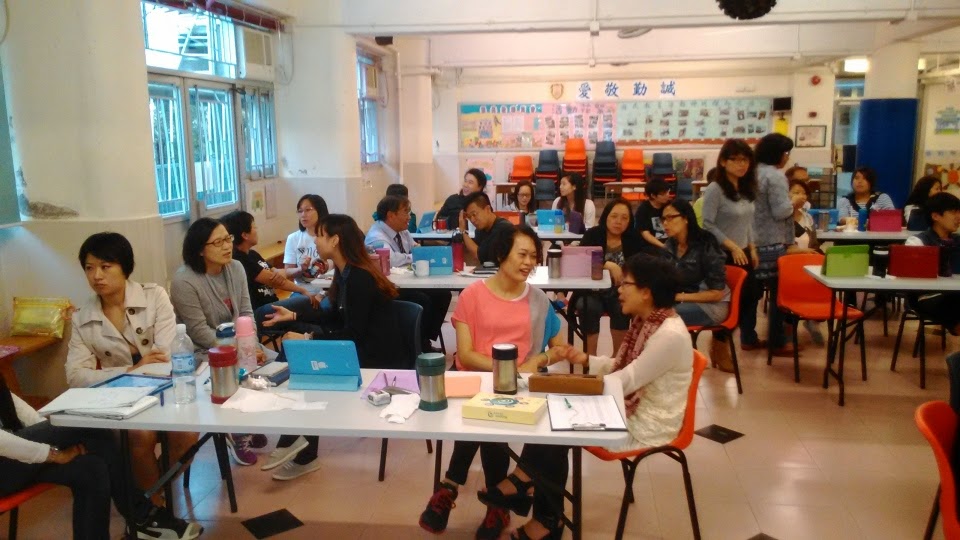
Yesterday, I was given the honor of working with the faculty and staff of the PLK Anita L.L. Chan (Centenary) School in Hong Kong. This is a specialized school working with primarily students with special educational needs. The students got the day off during our full-day training session. We spent an entire day investigating ABC thinking, teamwork, and personal development. The class was engaged and excited, and our responses were good, overall. There were a few issues with language, which is to be expected when your speaker (me) is English-speaking and your class is Cantonese-speaking (but English proficient). For many of the participants, this was the first time for them to exercise their English skills for some time. Fortunately, our board member Kitty Ho was also presenting, and led most of the more conversation-intensive activities. Overall, a good and productive time was had by all. Thanks again to the faculty and staff for giving me the opportunity to work with such wonderful people!

Our participants during an activity


April 30, 2014

Too Much Information?

“Where is the Life we have lost in living?
Where is the wisdom we have lost in knowledge?
Where is the knowledge we have lost in information?”
—T.S. Eliot, The Rock (1934)

Every so often, you come across a thought that hits you hard.  As I have mentioned before in this blog, one of the greatest struggles the Mozambicans, or any historically suppressed people, face is an atrophied ability[1] to conceptualize. This often stems from a focused attempt by colonial or other oppressive powers to discourage their second-class (or lower) population from learning too much. This is terrible, but understandable and even expected, given the nature of power and what some people will do to hold onto it.

What is more disturbing, however, is to see symptoms of low conceptualization skills appearing in what are supposed to be (at least theoretically) “free” cultures[2]. As a teacher at the undergraduate level in the U.S., I have encountered many students who come from middle-class, if not affluent backgrounds, who have difficulty identifying cause-and-effect relationships, analyzing and prioritizing information, and generally understanding concepts, as opposed to mere memorization of facts. These characteristics are similar to those we find in historically suppressed cultures. Clearly, many of the students do not act like a suppressed people group, so barring abuse or other abnormal trauma, what would cause this lack of conceptualization in what is, for all intents and purposes, a conceptually-oriented culture?

It isn't that I am identifying anything new, either—most educators are aware of a general reduction of academic ability in U.S. students. It has been happening for years and continues to worsen, despite attempts to improve curriculum and develop more educational programs. What T.S. Eliot has pointed out, however, is that this may not just be a matter of poor education as much as it is an incorrect focus on the content of the lessons. That is, we are teaching students to acquire and regurgitate data and information—history, math, science, etc.—instead of helping them understand how to use the data they have available.

With the rise of the internet, we are now overwhelmed with information. Children today have access to more information than any other generation in known history. It is said you can learn nearly anything that humanity knows through the World Wide Web. The problem isn't with the information itself, but with understanding what to do with it. It is all too easy to just take information and apply it to situations it seems to fit, and presume we have an answer. I see this all the time in my teaching (often in the form of plagiarism, when a student fails to cite where they got their information). Unfortunately, this is usually not enough. Having information is useless unless you understand how to apply it. Explaining how to organize and prioritize the data you have, as well as identify the consequences and formulate a response, is not something that we are currently teaching in most schools. Others are voicing similar opinions, and I feel the need to add my own voice to the chorus: we need to stop focusing on teaching students data, and start focusing on teaching students data organization, analysis, and problem-solving.

This will help students make better use of the massive amount of information that is available. I do not mean that they will merely to be better at research, but they will be better able to determine what information is important to their personal goals and development. That is, they need to know not only what data will help them in class or at work, but what will help them become better people. This way, they can not only have information, but also knowledge, that is, a personal comprehension of the data. Understanding how to use this knowledge helps us develop wisdom. It is my hope that such wisdom can help people learn how to truly live.


[1] As always, lack of ability in no way implies lack of capacity. Just because no one ever taught you how to drive a car, it doesn't mean you can’t learn—it just means you haven’t.
[2] For my purposes, a “free” culture is one which has not been deliberately suppressed in the recent memory of its people. Many (though not all) Caucasian people groups would fit this category, as well as some Asian groups, and a few others.

January 31, 2014

Away Longer Than I Thought

Well...so much for two posts in December.

This is only technically a post in January, so I have to admit to having effectively missed another month. In my defense, I was busy in December and January: December was a trip to Spokane, WA and January included a trip to Manhattan, KS. In addition, I had fall semester wrap-up and spring semester start-up and Christmas in between. So I was busy, but I still feel like I should have gotten another post in.

In order to keep this from being entirely an apology post, I will take a bit of space to discuss part of IRI's theories on cognition and learning. Specifically, the difference between what we refer to as "Direct" and "Indirect" understanding. I don't claim these ideas are new - I have seen allusions to them in several places - but they are a pretty core part of what we've been working on, and I think it is interesting stuff.

Essentially, direct understanding is grasping an idea, and understanding it in a way that makes it "yours." That is, you are comfortable enough with the concept that you can examine, review, critique, and modify the concept based on how it relates to other ideas without having to resort to asking others what to do with it. Indirect understanding, on the other hand, is grasping an idea through an intermediary - a teacher, a book, a blog, etc. Initially, all our understanding is indirect, but our goal is a direct understanding of any important concepts we work with.


One of the problems we have run into in our work is that most teaching (nearly all, really), emphasizes indirect understanding. That is, we learn through others - I give you information, and then we're done. In some contexts, this is necessary (like this blog, where I am limited in how I can engage you, the learner), and often isn't a real problem. Often, the data alone is sufficient to our purpose.

Unfortunately, there are many cases where ideas need to be internalized to use them successfully - as in the case of any scenarios that require manipulating the ideas to form new conclusions (analysis, problem solving, etc.). In these cases, the learner needs to form a direct understanding of key concepts in order to develop new ideas, but, all too often, our educational system simply leaves them with an indirect understanding. This can drastically hinder the process of innovation and adaptation in both an individual and a culture. A lot of our work at IRI goes into figuring out ways to help people move from indirect to direct understanding in areas critical for their development.

Fortunately, there are ways to do this, and once we get people thinking about how to make that transition, they start to develop their own systems in addition to what we have come up with - a kind of learning snowball effect. Developing direct understanding, however, is often a slow, time consuming process, at least at first. This is one reason why IRI's programs seemed to only progress slowly in the first few years, and then we suddenly started talking about the multiple business start-ups, new training programs in the works, etc. The initial start is a slow burn, but once the project gets going, well...there is a reason we don't feel that we need to be in Mozambique all the time now. The Mozambicans, having developed a direct understanding of several key principles of development, are now developing themselves like crazy.

It's amazing, and there is much more I can say (and probably will later), but I think I have a long enough post for today. Have a great new year, and thanks for your interest!

December 4, 2013

Website Recommendation: TED Talks

I intended to post this a few days ago, so I missed a month. I shall try to make it up this month with two posts. Today's item of interest is TED Talks, a website that is about...well, nearly everything.

TED Talks is basically a forum for introducing or expanding on new, interesting, or important ideas. The topics cover areas of science, technology, entertainment, anthropology, and a host of other issues (there are easily over 200 topics listed on the website). The views are informed and diverse, sparking some very thought-provoking ideas. While I don't always agree with what is said, I always come away with a better perspective on how people are investigating current issues.

It is a good site. Go take a look: http://www.ted.com/talks

October 31, 2013

Insight into Websites: Extra Credits

I’m beginning my reviews with an admission – I like computer games. This isn't really much of a revelation to anyone who knows me, though some often wonder why I have such an interest. For those people, and for anyone else interested in the structure, meaning, and purpose of games, I offer you my first website of interest, Extra Credits.

Extra Credits is a video series that highlights aspects of games, gaming, and the game industry that many people overlook or are simply ignorant of. Their videos cover a diverse range of topics such as game design, storytelling in games, the use of games as educational tools, and even compulsive video game play. All of the topics covered are treated with a serious professional focus, which reflects the experience the show’s staff has with the topic. At the same time, the subjects are presented in a fun, interesting way that makes it easy for newcomers to get a grasp of what is being examined and why it is important.

It is a simple fact that video games have become a part of the lives of nearly anyone who uses computer technology. From elaborate big-budget titles like Call of Duty to small, simple games like any one of many electronic Sudoku variants, games are everywhere you find computers (or cell phones). The question of what to do about and with them is, therefore, important. While many people immerse themselves a bit too deeply in games, others make the mistake of dismissing them as “immature” or “kids’ stuff”. Extra Credits, in my opinion, does an admirable job of highlighting just how complex games can be, and how substantially they can impact our society, for ill or for good.

Even if you have no interest in games at all, some of the topics (e.g. gaming in education), may still be of interest, just because of the ideas that are tossed around. Because of this, and EC’s mature, accessible, and lighthearted approach, I strongly recommend people give this series a try.

To visit the Extra Credits website, follow this link:
http://www.penny-arcade.com/patv/show/extra-credits

October 10, 2013

Doing Much but Saying Little

I’ve been a bit quieter than I expected lately, on account of keeping busy. I have been working on several different things at once – teaching at LCU, helping reorganize parts of IRI, reviewing the training materials for use in our South Africa and Hong Kong pilots, meeting with prospective partners, etc. Unfortunately, while this makes my life interesting, it doesn't necessarily make for good blog posts:

“Today I read books. Then I reviewed the training material I am working on. Then I edited the material a bit. Then I had a meeting. Then I graded papers.”

This is not exactly gripping reading.

So in an attempt to add some actual useful content to this blog, I am going to try to write up a short review of some of the reading I am doing. Some of this will be books we are using in some classes (real books that non-student people read, not just academic books), some of it will be reading of my own, whether that be books, blogs, interesting news articles, etc. I posted that I wanted to do things like this before, and now, with my more academic focus this year, I think I can actually pull them off.

Let’s give it a try.

Check in later this month for my first installment – I have a  couple articles and blogs I have been reading that have posed some interesting questions, so that seems like a good place to start.
Have a great October!

September 9, 2013

Still Alive

Well, I haven't posted in a longer time than I would have liked, but I am still alive. I am currently working at Lincoln Christian University, acting as their Missionary-in-Residence, which, roughly, means that I am "in charge" of helping students understand their role as ministers and missionaries. I am also helping lead a worldview class, which is immensely fun.

In the meantime, I am working on the several pilot programs IRI has scheduled for the next 12 months. The closest up is the one in December in South Africa, which seems to be progressing well. The other three are in Hong Kong, the Philippines, and Myanmar in 2014. I am working with our board member in Hong Kong on the pilot there, and Al is setting up the other two. In addition, I have at least two leads I am working on which may result in pilot seminars in the U.S. sometime in the next 8-12 months. If all goes well, I can use these seminars to train some additional presenters to help us cover the increase in work we will experience when the pilots we have scheduled provide us with proof-of-concept for educators in South Africa and Hong Kong.

So things are going well, and I am busy. Speaking of which, it is time to get back to grading - it turns out my students actually want to know how well they do on their assignments. Imagine that.